OnBeat
A system that adapts the music a person hears during exercise to their workout intensity in real time, using physiological and activity signals from a wearable.
Music that adapts to workout intensity.
OnBeat is a final project from Shenkar's Software Engineering Department. Instead of a fixed playlist, it adapts the music during exercise to the intensity of the workout, as indicated by heart rate and other activity signals from a wearable device.
The system combines a smart ring, a mobile application, backend services and recommendation logic in a single product.
Recognition
Outstanding Final Project, Shenkar, 2025.
Four parts of one system.
Wearable data
A smart ring provides the physiological and activity signals that the system responds to.
Mobile application
The user-facing application is built with React Native.
Backend services
Backend services are implemented in Python.
Recommendation logic
Recommendation logic chooses music in response to the measured intensity of the workout.
The team documented the project in a proposal, a software requirements specification, a validation report and a final Project Book.
Within-subject testing with and without adaptive music.
The student final report describes a validation study with 20 participants, each completing runs with and without OnBeat. The reported results show a 13.8% average improvement in the project's run score, an 11.2% increase in heart-rate-zone compliance, and improvement for 85% of participants.
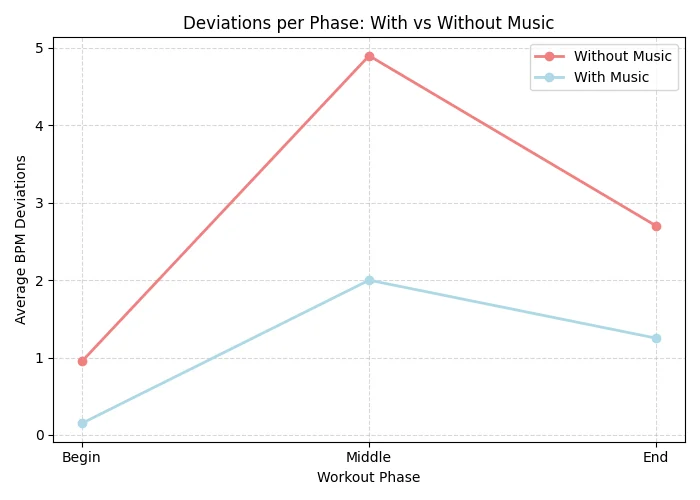
The report also records fewer BPM deviations in the beginning, middle and end phases when adaptive music was used, with the largest average reduction in the middle phase.
These are results reported in the supervised student project's final validation study.
Validation design
- 20 participants
- Within-subject comparison
- Runs with and without adaptive music
- Heart-rate-zone compliance and run-score metrics
Final report, official page and coverage.
The student final report, Shenkar's graduate project page and press coverage of the project.
Final project, Shenkar Software Engineering, 2024–2025.
Built by Maayan Babayoff, Lotem Yaakobian and Nikolai Melnichev.