Stability of Leveraged ETF Performance
An empirical study of how leveraged ETFs behave over time, focusing on leverage, volatility, compounding, path dependence and the stability of observed performance.
How stable is leveraged ETF performance?
Background: leveraged ETFs are designed to deliver a multiple of an index's return over a fixed interval, typically one day. Over longer holding periods, compounding and volatility can make results differ from a simple multiple of the index return.
The project examines this behaviour empirically, using backtesting. Its official project abstract is titled “Timing and Risk in Leveraged ETF Investing.”
Research and educational content only. Nothing on this page is investment advice.
Topics studied
- Leverage
- Volatility and volatility drag
- Compounding
- Path dependence
- Holding-period stability
- Risk-adjusted performance
Holding the instrument constant and moving the entry date.
The final report analyzes 18 leveraged ETFs matched to 16 benchmarks. For each fund, the students simulate nine annual entry dates and evaluate two holding rules: holding from entry to the common end date, and a fixed one-year holding period.
This produces 324 entry cases in total, including 162 fixed one-year cases designed to isolate entry timing from holding-period length.
Controlled comparison
- Same starting capital for each simulated position
- Nine annual entry dates
- Variable and fixed one-year holding rules
- Geometric mean of daily returns
- Return, variance and compounding-path comparison
One fund, nine entry dates.
The report illustrates the design with a simulated 3x QQQ fund (TQQQ): the same $100, started at nine different annual entry dates, ends at very different values.
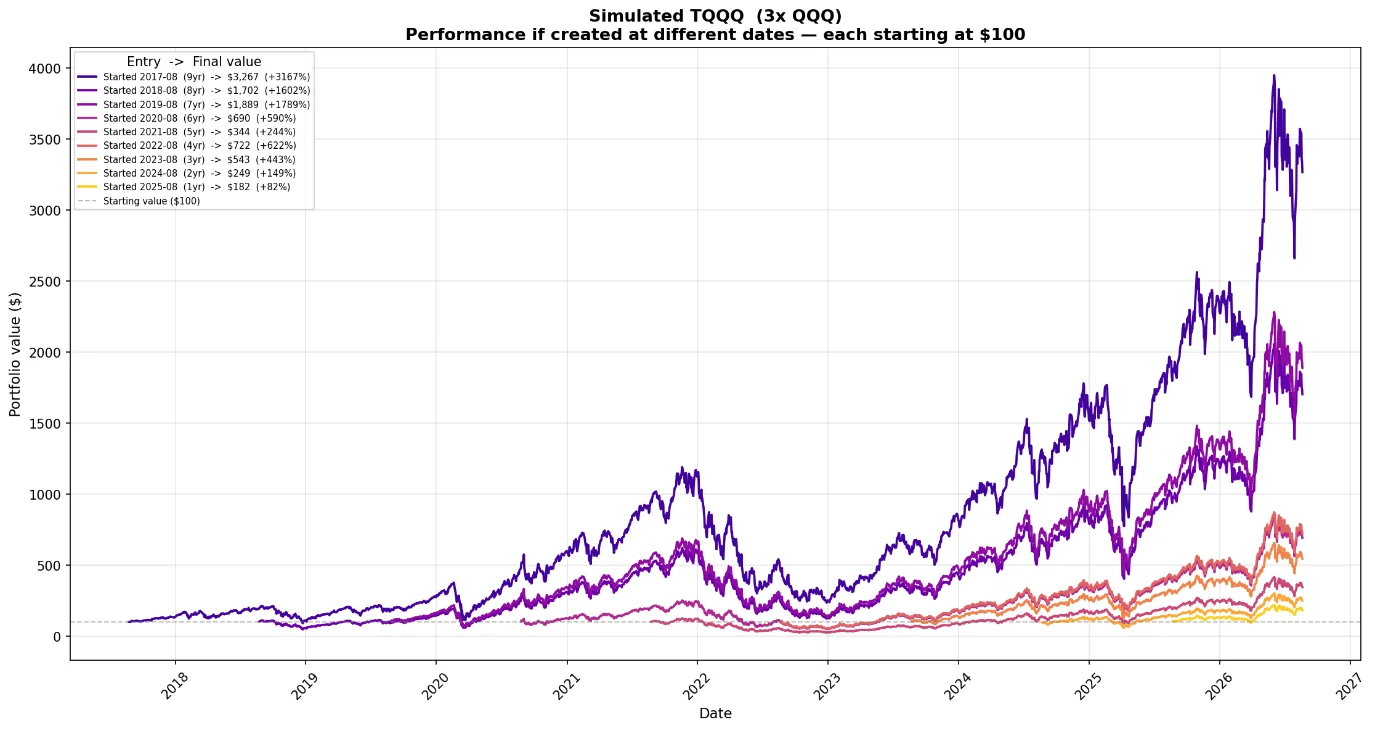
Entry timing materially changes the leveraged path.
Across the 18 funds, the report finds that simulated positions starting from the same capital can diverge substantially when only the entry date changes. The effect appears in terminal return, variance and mean daily compounded return, and becomes more consequential under leverage because the volatility environment is amplified.
In the study, four of the 18 leveraged funds had a negative compounded mean daily return over the analyzed period; for two of them, the corresponding benchmark compounded positively.
These are empirical findings from the supervised student project and are not a prediction of future ETF performance.
Risk-adjusted performance, from another angle.
A related SCE project compares classical risk-adjusted ratios with a structural score across market regimes: Data-Driven Risk-Adjusted Performance Analysis.
Student research project, SCE Computer Science, Beer Sheva.
Carried out by Daniel Shub and Pavel Zaikin in 2025–2026.